• Home
  • Español
  • English
  • About
Menu

Natalia Curonisy

Street Address
City, State, Zip
Phone Number

Natalia Curonisy

  • Home
  • Español
  • English
  • About

Are You Really Living?

April 20, 2024 Natalia Curonisy

Photo by Robin Worrall on Unsplash

We're all guilty of it—getting caught up in the hustle and grind, rushing through our days on autopilot. We get so caught up in the grind, obsessing over our productivity and to-do lists, that we completely miss out on actually living.

Seneca warned against this trap over 2,000 years ago: "You are living as if destined to live forever; your own frailty never occurs to you... How late it is to begin really to live just when life must end!"

Harsh words, but he speaks the truth. It's like a wake-up call. It's a total paradox when you think about it. As Annie Dillard said, "The world is bursting with wonder, and yet it's the rare productivity guru who seems to have considered the possibility that the ultimate point of all our frenetic doing might be to experience more of that wonder." We're so focused on checking boxes that we completely miss the mind-blowing fact that we're even here, alive and conscious, in this vast mysterious universe.

Seneca puts it beautifully—we've been given this "spell of time" to experience the profound gift of existence. Too often, we just let it "rush by so swiftly" without truly soaking it in and appreciating the magic. It's time for a wake-up call. It's time to stop sleepwalking and start living with real vivid presence and intensity.

The amazing thing is, it's so simple to unlock. We just have to make the choice to pause, look around with fresh eyes, and be here now. Breathe in every moment we're given like it's our last. Because you know what? It very well could be.

Life is happening this very second, all around us and within us. Are you going to keep snoozing through it? Or are you finally going to start living?

Comment

The $1,000 Potential Investment: Who Would You Bet On and Why?

April 13, 2024 Natalia Curonisy

Photo by mauro mora on Unsplash

Imagine you had $1,000 to invest in someone's future potential. But there's a catch—it has to be someone you know personally, someone you trust, someone you believe in, someone you would rely on. How would you make that decision?

Conor Neill issued this provocative challenge to a TED audience. It's a question that forces you to define what makes someone a wise "investment." What specific criteria would you use to choose the person most worthy of your investment? The usual criteria like skills, qualifications, and past achievements only skim the surface. 

When legendary investor Warren Buffett evaluated people, he went deeper - prioritizing Integrity, energy, and intelligence above all else.

Take a moment to clearly define your own criteria. What core values, habits, skills, knowledge, and deep motivations would you prioritize? Who in your life would be worthy of that investment?

More importantly, would you bet on yourself?

These are not easy questions to answer. But if you apply Buffett's three-filter test rigorously to your own life, how do you measure up? Are you truly nurturing personal integrity through your actions and choices? Do you bring infectious energy and vitality to pursuing your goals and dreams? Are you continuously stretching your intellectual limits and hunger for learning?

Our life journey is shaped by a series of choices and actions, some easier than others. But these choices compound over time and ultimately define our future potential. We often underestimate what we can achieve in a year, but overestimate what we can achieve in a single day.

In the story of your life, the most important book is the one you write.

The path to becoming exceptional begins when you take full responsibility for your actions, no matter the situation or circumstances.

Comment

World Down Syndrome Day

March 16, 2024 Natalia Curonisy

Meet Massimo.

March 21 is a special day—World Down Syndrome Day. For Massimo and our family, every day is Down Syndrome Day.

World Down Syndrome Day (WDSD) is celebrated every year on March 21st.  Why March 21st? Because it symbolizes the extra copy of the 21st chromosome that individuals with Down syndrome are born with.

My hope for Massimo –and everybody else whose life has been touched by Down Syndrome– is that he will be fully included in society. My desire is that we all put our best effort into ending the stereotypes that prevent them from having the right environment to develop their maximum potential.

Stereotypes can be a barrier for individuals with Down Syndrome and other disabilities. They can prevent us from being treated equally. We believe labels shouldn't define us. Discrimination should never change who you are. With the right support and opportunities, individuals with Down syndrome can achieve amazing things. People might say, "They can't.…" but as Massimo and others like him demonstrate every day, "They will."

Let's remember that it's not our differences that divide us; it's our inability to recognize, accept, embrace, and celebrate those differences.

Join us in spreading the message of inclusion and acceptance on this World Down Syndrome Day.

Comment

How to Inspire Change With Words

March 9, 2024 Natalia Curonisy

One common question that leaders ask me is how they can be more effective leaders. As people continue growing in the organization, they stop listening to insightful feedback that can guide them to lead their teams. Leaders need to make things happen and learn how to motivate people. Does this sound familiar to you?

 We are living in an important transitional moment, where jobs don't fit into neat boxes anymore, offices aren't the only places to work, and many people don't have or don't want the typical jobs. Most people are looking for more meaningful reasons to do their best because they have it very clear they have a life besides work.

 When we want to convince and inspire others, we need to think differently. The way we talk plays a huge role in this, and the good news is that it doesn't cost anything. We can choose any words we want to create an impactful message. But doing it well—making it memorable and powerful—is quite tricky. Rhetorical leadership is an influential leadership style that involves the strategic use of language and communication techniques to inspire, motivate, and guide others.

Here are eight tools you can consider:

The Power of Clear and Simple Communication
Clear and simple language is fundamental to effective leadership communication. Imagine vividly painting your vision with words that everyone can understand. Research by the Harvard Business Review emphasizes that leaders who communicate with clarity break down barriers and invite everyone to join the journey, fostering a shared understanding that fuels collective action.

Tapping into Emotions for Lasting Impact
Great leaders stir emotions in addition to mastering logic. Different studies and experts support the idea that emotional connections create a sense of shared experience. Whether through personal anecdotes, powerful metaphors, or relatable stories, the ability to evoke emotions can inspire passion and commitment, turning a group into a united and motivated team.

Crafting a Compelling Vision
A compelling vision is the North Star that guides successful leaders. Picture the future you aspire to create and articulate it with passion. Harvard Business Review notes that a well-crafted vision becomes a rallying point, aligning everyone toward a common purpose.

Building Trust through Authenticity
Trust is the bedrock of leadership, and authenticity is its currency. Leaders who openly share experiences, vulnerabilities, and triumphs build trust with their teams. Authenticity breeds credibility, creating a foundation for building strong and enduring relationships.

 Empowering and Inclusive Language
Language has the power to uplift and empower. Leaders who use inclusive language make everyone feel valued and essential to collective success. According to Forbes insights, leaders foster a sense of belonging by emphasizing "we" over "I,” motivating individuals to contribute their best towards shared goals.

Mastering the Art of Repetition
Repetition is not just for memorization; it's a strategic device to emphasize key messages. Harvard Business Review notes that by reinforcing crucial points, leaders ensure their vision and goals remain in everyone's minds. Repetition fosters clarity and helps embed the desired mindset within the team.

Embracing Positive Framing
In the face of challenges, great leaders frame setbacks as opportunities for growth. Forbes suggests that leaders cultivate a resilient and optimistic culture by focusing on solutions and positive outcomes. Positivity becomes contagious, creating an environment where obstacles are viewed as stepping stones rather than roadblocks.

The Strategic Use of Silence
Sometimes, the most profound messages are communicated in silence. Leaders who strategically use pauses allow their words to resonate. Silence creates a moment for reflection and emphasizes the gravity of the message, leaving a lasting impact on the audience.

These are eight powerful communication strategies. However, their effectiveness relies on how consistently leaders embody their values. Hypocrisy can quickly erode trust, and we all quickly notice and dislike it.

As you embark on your leadership journey, remember that your words have the power to shape the future—choose them wisely.

Comment

Doing the Right Things Even When It's Hard

March 2, 2024 Natalia Curonisy

When times are challenging, we cannot let spontaneity or emotion lead our actions. Because, among other things, we cannot always control our emotions or invoke them at will. We need to develop our character so that we can act according to what we think is the right thing to do.

How are you forging your character so you can stay calm in tough times, be fair under pressure, act consistently in complex situations, and be courageous when things are unfair?

Being aware and willing is not enough to make a good decision, as only those who have the habit of acting rightly are capable of following their conscience. Additionally, besides knowing what is good, they also have the strength to act accordingly.

Leadership is a decision and so are the actions you're taking to be a better person and a better leader.

Comment

Not Everything Has to Be Okay

February 24, 2024 Natalia Curonisy

Photo by Ferenc Horvath on Unsplash

Have you ever reflected on how you embrace challenges?
We often find people very energetic and positive when they start a new project or a new role or when they hit the target results. However, in the long game, not everything is okay.

Sometimes, we forget that the most important life decisions are long-term. So, we are not going to see any results at the end of the month. (if you have ever been in a commercial role, you know how important the end of the month is) and we need to build resilience and be consistent if we want to move forward.

In long-term goals, the results are not linear, and there are no quick wins, so the probability that something does not go well —even when you know you made the right decision— is very high. And it is ok if we learn how to embrace it, learn from the process, and keep playing.

In the short term, we need to prioritize, focus, and accept that not everything will work as expected. We should be more concerned with our current trajectory than with our current results.

A few years ago, I heard from Seth Godin this powerful concept: "The person who fails most wins."
When we see failure as part of the learning process, we gain valuable experience and knowledge. But you know that it's not always easy. That's why we need to learn to embrace failure. Even better, change our concept of failure to one that we deeply understand that this is only part of the growth process.

If you have a great idea, you must test it, interact and engage with the market, and see what happens. Then, adjust what is needed and move forward, but you have to ship it. Tiny steps are the ones that will define your future self.

Comment

Tribute to Richard Feynman

February 17, 2024 Natalia Curonisy

Richard Feynman (11 May 1918 – 15 February 1988) was an incredible scientist. Known for his contributions to the development of quantum electrodynamics, Feynman received the Nobel Prize in Physics in 1965, sharing it with Julian Schwinger and Shin'ichirō Tomonaga for their independent work.

 Feynman wasn’t famous just for being a world-class scientist; even more importantly, he was an amazing teacher. He leveraged the power of teaching to improve learning.

He did a series of lectures that are still available, which were for people who didn't specialize in physics. He was a great example of how one could explain things in a fun and interesting way to anyone. He used very simple concepts to explain how physics worked.

Despite his accomplishments, Feynman considered himself “an ordinary person who studied hard.” He believed that anyone was capable of learning with enough effort, even complex subjects like quantum mechanics and electromagnetic fields:

There’s no miracle people. It just happens they got interested in this thing, and they learned all this stuff. There’s just people. —Richard Feynman

He pushed himself to have a deep understanding. His approach to knowledge was always looking for different possibilities.

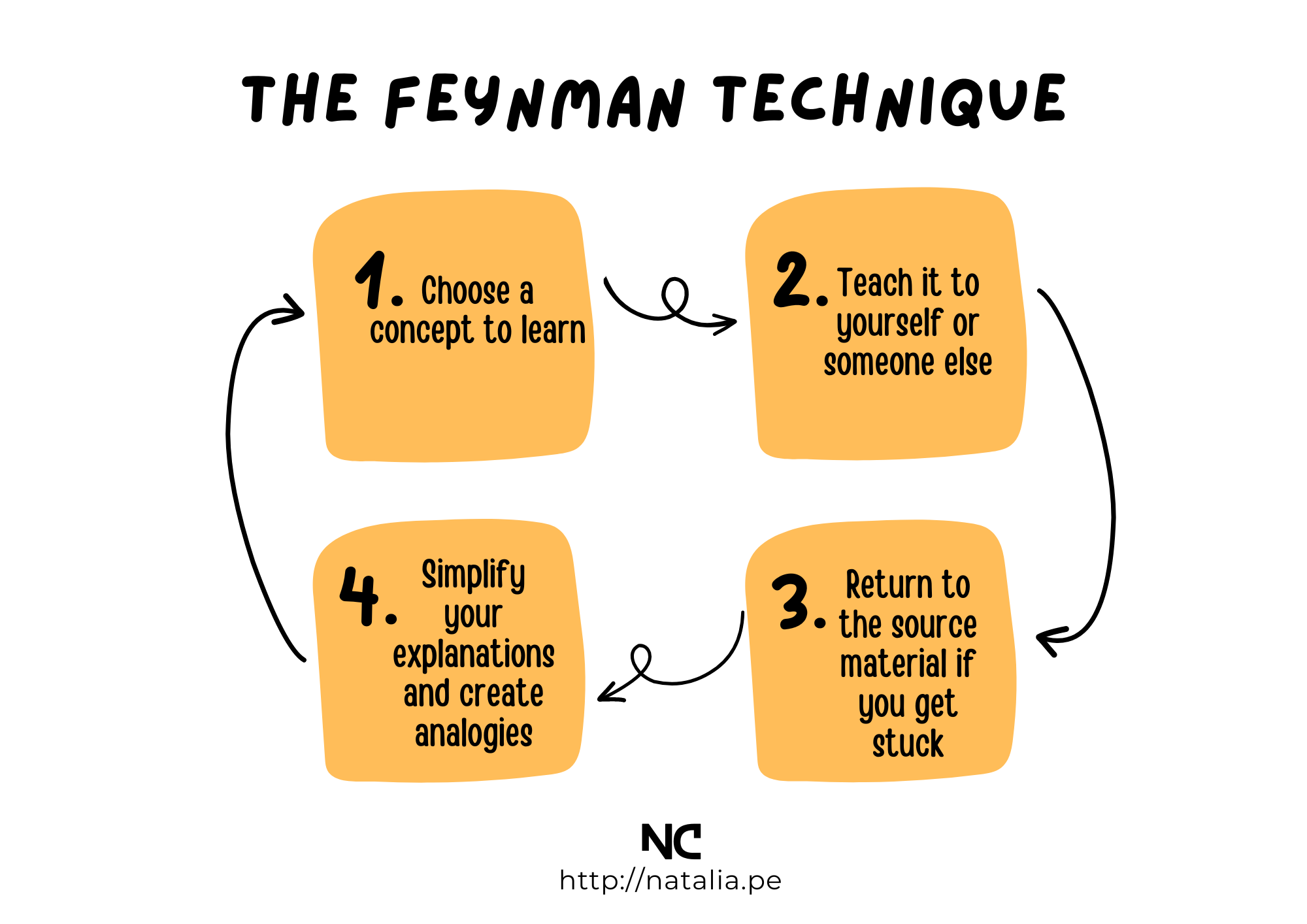
Throughout his work and life, Feynman provided insights into his process for considering complex concepts in the world of physics and distilling knowledge and ideas with fun and simplicity. Many of these observations about his learning process have been collected into what we now call “The Feynman Technique.” 

The Feynman Technique is a four-step process for understanding any topic. This technique rejects automated recall in favor of true comprehension gained through selection, research, writing, explaining, and refining.

True understanding requires a more active process. The Feynman learning technique is a way to learn new concepts thoroughly by teaching them to others or at least pretending to.

The worthwhile problems are the ones you can really solve or help solve, the ones you can really contribute something to… No problem is too small or too trivial if we can really do something about it. —Richard Feynman

Comment

How to identify High Potential Employees

February 10, 2024 Natalia Curonisy

Photo by Kelli McClintock on Unsplash

We all want to work with the most talented people. Being surrounded by talented people impacts our organization and our results and increases our expectations of what can be accomplished. We want to have the best talent on our teams, and it's a constant challenge to identify them.

But let's start with how you measure potential.

How do you measure potential?

The most common practice is to look into past performance. We are used to looking at where people start, how far they grow, and how fast they reach the highest point.

As part of the selection process, people look for test scores and educational background.

But you could be looking at false indicators. As Adam Grant highlighted: "Potential is not a matter of where you start, but how far you travel. We need to focus less on starting points and more on distance traveled. (...) When we confuse past performance with future potential, we miss out on people whose achievements have involved overcoming major obstacles."

For many years, people assumed that potential was a gift, whether you had it or not. Only if you are lucky enough to be "gifted" will you be able to accomplish greater things. And even now, many companies are looking for gifted and talented people. Thankfully, this is changing.

Everyone has potential, and we can learn to develop it. Growth is not about how hard you work but how well you learn. We all can learn.

With the right opportunity and motivation to learn, anyone can build the skills to achieve greater things.

Are you really looking for a person who wants to transform things for the better? Knowing people's drivers, characters, and values can help you understand if they are looking for status or if someone really cares enough to seek and make a difference. 

Learning is a process we choose to go through, and learning needs to happen more.

We can continue doing the process as we know and have always done, but we can choose to do better. We can give more people the chance to achieve greater things. We can and have the responsibility to create and improve our systems to allow more people to thrive —regardless of their background.

We can choose to level up.

Instead of only looking for geniuses where we expect to find them, we can reach humanity's greatest potential by cultivating the genius in everyone.
—Adam Grant

Comment

Charlie Munger on three rules to be successful in life

February 3, 2024 Natalia Curonisy

Charlie Munger, the billionaire investor and Warren Buffett's business partner and right hand, passed away on November 28 at the age of 99. He was one of the most brilliant minds who inspired and influenced so many people with his wisdom, including myself.

Charlie's Munger journey to career satisfaction was far from linear. Munger reflected on his experiences, offering invaluable insights into his unconventional path. He shared that he had three fundamental rules:

I have three basic rules for career satisfaction that have always helped me. While meeting all three is nearly impossible, you should try anyway.

1. Don’t sell anything you wouldn’t buy yourself: The safest way to try to get what you want is to try to deserve what you want. It’s such a simple idea. It’s the golden rule. You want to deliver to the world what you would buy if you were on the other end.
There is no ethos, in my opinion, that is better for any person to have. By and large, the people who have had this ethos win in life, and they don’t win just money and honors — they win the respect and the deserved trust of the people they deal with.
Plus, there is huge pleasure in life to be obtained from getting deserved trust. Reputation and integrity are your most valuable assets — and can be lost in a heartbeat.

2. Don’t work for anyone you don’t respect and admire: You particularly want to avoid working directly under somebody you don’t admire and don’t want to be like. It’s dangerous.
We’re all subject to control to some extent by authority figures, particularly authority figures who are rewarding us. Dealing properly with this danger requires both some talent and will.
I coped in my time by identifying people I admired and by maneuvering, mostly without criticizing anybody, so that I was usually working under the right sort of people. A lot of employers will permit that if you’re shrewd enough to work it out with some tact.
Generally, your outcome in life will be more satisfactory if you work under people whom you correctly admire.

3. Work only with people you enjoy: I’ve found that intense interest in any subject is indispensable if you’re really going to excel. I could force myself to be fairly good in a lot of things, but I couldn’t excel in anything in which I didn’t have an intense interest or enjoy.
If at all feasible, you want to maneuver yourself into doing something in which you have an intense interest alongside people whose company you enjoy. 
Another thing you have to do is have a lot of assiduity. I like that word because, to me, it means: “Sit down on your ass until you do it.” I’ve had marvelous partners, full of assiduity, all my life. I think I got them partly because I tried to deserve them, and partly because I was shrewd enough to select them, and partly because there was some luck.

Munger's wisdom extends beyond these rules. As a legendary and pragmatic investor and active philanthropist, Munger was known for his wide-ranging wisdom across many disciplines — including psychology, economics, biology, history, and physics. Charlie Munger's life was a testament to the impact of wise career choices. To learn more about his insights, "Poor Charlie's Almanack" is a good start.

1 Comment

How to make great decisions

January 27, 2024 Natalia Curonisy

No one has taught us how to make great decisions, and the decisions we make daily could make all the difference in our lives and how we decide to live them.

Some decisions with low impact are reversible, while others with high impact are not. Usually, we stop to think about the high impact of, for example, getting married, accepting a job offer, or investing our savings. However, on low-impact decisions, we tend to go in automatically and dismiss the compound effect in our daily choices. For example, eating healthy food, exercising, or setting aside time to spend quality time with our family.

Learning how to make great decisions will make a huge difference in our lives, like getting the best results, achieving our goals, solving problems, building trust, and, not less importantly, driving us to the person we want to be and establishing our personal growth. The quality of our decisions eventually determines how far we go.

Improving our decision process is not only a skill but a series of tools and frameworks that we can learn to incorporate into our mental toolbox. Learning to make great decisions consistently will help us improve our lives and move above average or merely good.

In his book Clear Thinking, Shane Parrish shared insightful guidelines for making wiser decisions each day.

One important factor to improve our decisions is knowing our blind spots and managing them. If we don’t, the defaults will take control.

There is a gap in our thinking that comes from believing that the way we see the world is the way the world really works. Only when we change our perspective—when we look at the situation through the eyes of other people—do we realize what we’re missing. We begin to appreciate our own blind spots and see what we’ve been missing. 
—Shane Parrish

In his book, he shared two principles to evaluate and improve our decision process:

  1. The process principle: When you evaluate a decision, focus on the process you used to make the decision and not the outcome. Even the best decision-makers get bad results from time to time, though. Making a good decision is about the process, not the outcome

  2. The transparency principle: Make your decision-making process as visible and open to scrutiny as possible. If you don’t check your thinking at the time you made the decision—what you knew, what you thought was important, and how you reasoned about it—you’ll never know whether you made a good decision or just got lucky.

 He continues reflecting on the importance of good decisions:

Most errors in judgment happen when we don’t know we’re supposed to be exercising judgment. They happen because our subconscious is driving our behaviors and cutting us out of the process of determining what we should do. (...) Managing your defaults requires more than willpower. (...) Overriding your defaults requires implementing safeguards that render the invisible visible and that prevent you from acting too soon. And it requires cultivating habits of mind—accountability, knowledge, discipline, and confidence—that put you on the right track and keep you there.

The improvement you make in your decision process compounds.  All good decisions are effective, but not all effective decisions are good. The actions we take today are the actions that will separate our past from our future.

¿What are you doing to learn how to improve your decision-making process?

Comment

The worst behavior you tolerate determines the culture of your organization

January 20, 2024 Natalia Curonisy

What do you do if you find a person stealing at work?

  • Do you confront them and ask what's going on?

  • Do you report them to their supervisor?

  • Do you report them to the legal department or the corresponding department?

  • Do you do nothing? After all, it's not your concern.

The likelihood of overlooking theft is very low. In many countries, it is considered serious misconduct and means the immediate termination of the employment relationship. Regardless of the amount, it is an act that breaks trust and the person's credibility. It is highly unlikely that anyone would question the termination of an employee for theft.

The question is, what happens when you have a star performer in your organization who consistently delivers results and helps grow the organization's sales but at the expense of mistreating other people? What if this same person disrespects a colleague or abuses their authority to get things done?

What do we do with that person? When similar situations arise, people often categorize it as a gray area. Unfortunately, many times, nothing is done.

We usually justify results to allow behaviors we would not tolerate in others. Worse yet, these are often the people who are promoted or internally recognized without even evaluating their impact on the organization.

People and teamwork are your greatest competitive advantage. To understand your organization's culture, it is important to go deep and understand what each process in the company is telling employees about what is important.

One of my favorite definitions of culture is "the way things are done here." But understanding what creates culture cannot be better captured than in the quote by Gruenter and Whitaker:
"The culture of any organization is determined by the worst behavior the leader is willing to tolerate."

What are you doing to think strategically and create systems that allow you to manage people and teams to gain a competitive advantage?

Comment

Leading with Purpose: Making a Lasting Impact Beyond Numbers

January 13, 2024 Natalia Curonisy

If you are a leader driven by numbers or results, looking for the short-term gratification of how the sales close at the end of the month or the quarter, you may ask yourself how to make this sustainable.

How often do we think it is okay to postpone things that we consider important but delay them because we know we will not see any result in a short time? How many times, conscious or not, are we looking for short-term recognition or self-accomplishment, like not having emails to respond to in our inbox? In the fast-paced world of leadership, it's easy to get caught up in immediate satisfaction.

How many times do we live our days in automatic, running from one meeting to another, leaving no time for reflection, and without wondering what it is for?

Pause for a moment; what are the most important things in your life?

As a leader, you have an extremely important responsibility —how you support and develop your people. As a leader, you have the responsibility to decide how you want to impact them.

As a leader, you lead by example. If you’re not encouraging your team to prioritize, to take care of themselves or their family, and you’re not showing them that you are doing it too, I would invite you to reflect on what are really the most important things in your life.

 Everyone has the power to decide. To make choices.

Take the time to reflect on what's in the influence that you are creating around you. Your family, kids, friends, colleagues, and reports are seeing you. As a leader, integrity is one of the most important values. Be coherent with what you say and what you do. How you treat people, how much you care about others, and the time you prioritize with your family are only reflections of who you are.

Comment

How to Stay Ahead in 2024?

January 6, 2024 Natalia Curonisy

Photo by Lindsay Henwood on Unsplash

Many articles are starting to appear, presenting predictions and trending initiatives that you should follow if you want to stay ahead. These articles seem like recipes, outlining actions you must take to avoid falling behind, and the recommendation is to start right away. Competition is intense, and information is everywhere, detailing the most advantageous practices that leading companies are putting in place.

A not-so-minor question arises: ahead of what? Following what's trendy and copying other companies' journeys can propel you further, but in the wrong direction.

If you do what everyone else does, you’ll get the same results that everyone else gets. Best practices aren’t always the best. By definition, they’re average.
— Shane Parrish.

Let's go back to basics. What problem do you want to solve?

You have plenty of resources and information. However, instead of looking at what other companies are doing, you should turn to your customers, employees, and team. What problem do you need to solve, and how do you want to solve it?

Every organization and employee is unique, and there is no one-size-fits-all. There's no recipe. Take the time to talk with the people you are working with and determine what may be the best for your organization.

Comment

New Year Plan 2024

December 30, 2023 Natalia Curonisy

Planning the New Year has become like a tradition to create a space for reflection, review our dreams, and set next year's goals, with the promise that the upcoming year will be different.

I personally believe that every day is a new start. When we walk with consistency in the path of our deepest goals, we have the opportunity to get closer to the person we want to be.

Over the years, I've collected incredible processes and articles that have helped me to reflect, stay on track with my goals, and get awareness of how I am setting and focusing my best energy.

Here are a couple of my favorite go-to resources:

  1. Antifragile Planning by Taylor Pearson.
    This meaningful and practical process allows you to reflect on the things that you want to accomplish, and you need to focus but add the component of optionality.

  2. Reflect on the Past, Clarify the Future, by Conor Neil
    A set of questions to reflect on the past year that might help clarify how to make changes in your approach to the coming year.

As part of this reflection process, I started a daily journaling practice. Journaling has helped me to get clarity on what I really want and how to get there. With that experience, I developed my own journal with the best practices I found. You can get it for free here.

We have the opportunity to make each day count, focus on what really matters, and make this year our best one yet!

Comment

Every Day Matters

December 23, 2023 Natalia Curonisy

Photo by Lina Trochez on Unsplash

Every day is an opportunity to create our masterpiece, like a new canvas waiting for us to share what we can create, inspire others, and contribute with what we have learned.

Every day offers us a new opportunity to grow, embrace new challenges, and seek to experiment. Every day, we have the opportunity to connect, build meaningful relationships, express our gratitude, and truly care.

Your story matters, and the world is waiting to be inspired by it.

Comment

The Path to Transcendent Leadership

December 16, 2023 Natalia Curonisy

Photo by Marianna Lutkova on Unsplash

I’ve learned that self-knowledge is one of the key areas to develop for people to be able to lead successfully their professional, personal, and family lives. It involves understanding what motivates them in life.

The more self-knowledge I have, the easier it is to discover my vocation, my calling, or my purpose (or whatever you want to call it). When we realize that we are unique and unrepeatable, we understand that what we put on the table is unique, that our capacity and our heart are worth it, and we have the power to use it to add value, improve things, and serve others.

To know ourselves, we need to know about our aptitudes (abilities and skills), our attitudes, and our drivers. Nuria Chinchilla, Professor of Managing People in Organizations at IESE Business School, proposed an excellent framework for this discovery process.

You can use this discovery process from outside to inside as if you were peeling an onion.

  1. Interpersonal competencies are about how I work in a team, how I listen, and how I communicate. Even how I coach my friends or how I delegate.

  2. Intrapersonal competencies are related to how I manage myself: if I am capable of self-criticism, managing my time well, and managing stress well. If I am sufficiently proactive and have enough initiative.

  3. Meta-competences, also known as virtues, are at the core of everything. These are the positive habits that lead us to success. For example, prudence, justice, fortitude, and temperance (emotional intelligence) are the four cardinal virtues.

What is really important in this process are self-knowledge, self-management, and our drivers. Self-management is about what I'm doing to build my character and is needed to act accordingly. Our drivers can be extrinsic, intrinsic, or transcendent.

As a reflection, I believe that as leaders, we must not only help people develop their competencies but also identify what their drivers are. We should also help them improve their motivation so they become a better person. Help them so that they are not only driven by extrinsic or intrinsic motivation but to create a positive impact on others—transcendent motivation.

The best way to find yourself is to lose yourself in the service of others.
― Mahatma Gandhi

Comment

Do the Verb, Forget the Noun

December 9, 2023 Natalia Curonisy

Photo by Tetiana SHYSHKINA on Unsplash

Forget about the things that you are trying to accomplish (noun) and focus on the real work that you need to be doing (verb).

“Forget about being a Writer,” says novelist Ann Packer. “Follow the impulse to write.”

Austin Kleon wrote, "So many people think you have to first call yourself an artist, know who you are and what you’re about, and then you can start making art. No, no, no. You do the stuff first, then you can worry about what it is, who you are. The important thing is the practice. The doing. The verb."

Whatever you want to accomplish, you need to put the work first; you need to practice, focus on the actions, and be the verb. The noun will follow.

Focus on the verb will provide you with a clear action path of what you have to do; if you want to be a writer, write; if you want to be a great leader, be one.

We are the verb. Our actions define us.

Comment

In Memory of Charlie Munger

December 2, 2023 Natalia Curonisy

In memory of one of the most brilliant minds, Charlie Munger, who inspired and influenced so many people with his wisdom, including myself. Generous in sharing his learnings, Charlie Munger educated us about character, sense of humor, judgment, criteria, investing, and more. He passed away on November 28 at the age of 99.

Here are ten of the thousands of quotes we can share from this savvy man.

  1. "The best thing a human being can do is to help another human being know more."

  2. "In my whole life, I have known no wise people who didn't read all the time - none, zero."

  3. "It's not the strongest of the species that survive, nor the most intelligent, but the one most responsive to change."

  4. "I constantly see people rise in life who are not the smartest, sometimes not even the most diligent, but they are learning machines. They go to bed every night a little wiser than they were when they got up, and boy, does that help, particularly when you have a long run ahead of you."

  5. "The game of life is the game of everlasting learning. At least it is if you want to win."

  6. "You need a different checklist and different mental models for different companies. I can never make it easy by saying, 'Here are three things.' You have to derive it yourself to ingrain it in your head for the rest of your life."

  7. "The big money is not in the buying and selling, but in the waiting."

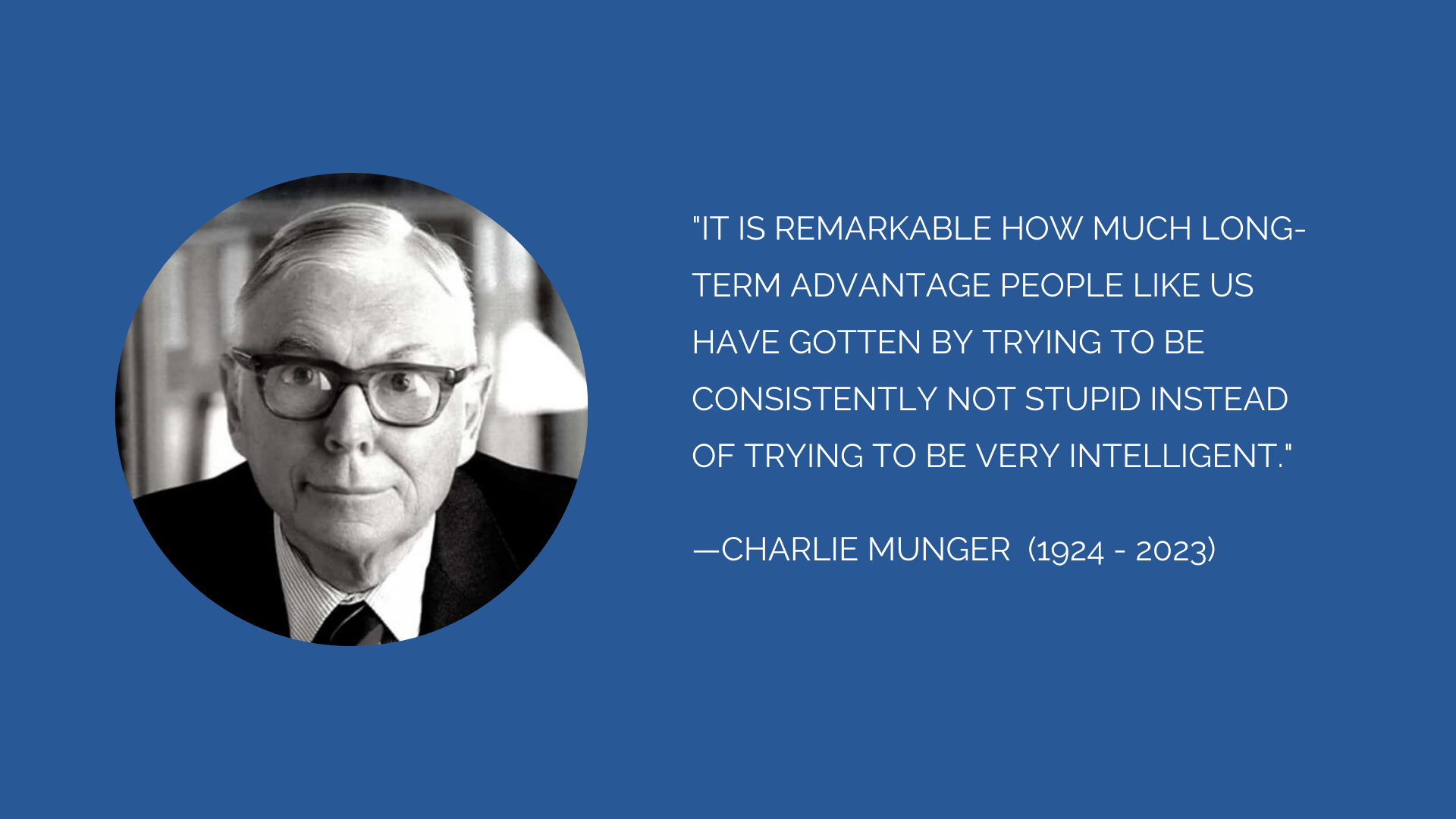
  8. "It is remarkable how much long-term advantage people like us have gotten by trying to be consistently not stupid instead of trying to be very intelligent."

  9. "All I want to know is where I'm going to die, so I'll never go there."

  10. “To get what you want, deserve what you want. Trust, success, and admiration are earned. It’s such a simple idea. It’s the golden rule, so to speak: You want to deliver to the world what you would buy if you were on the other end.”

Note: The quotes are paraphrased for brevity and clarity.

Comment

Prevent Team Burnout

November 25, 2023 Natalia Curonisy

Photo by Gift Habeshaw on Unsplash

The World Health Organization has identified burnout as chronic workplace stress that has not been successfully managed.

Three dimensions characterize burnout:

  • Feelings of energy depletion or exhaustion.

  • Increased mental distance from one’s job or feelings of negativism or cynicism related to one's job.

  • Reduced professional efficacy means essentially not feeling like we're good in our roles or we don't have the resources to do our jobs.

Unsustainable workloads have always been, and continue to be, the leading cause of burnout. We have this idea that more hours of work equals getting more work done. This is such an unfortunate myth. The truth is that working more than 10 hours a day is associated with a 60% jump in risk of cardiovascular issues, and working more than 40 hours a week is associated with unhealthy weight gain in men and depression in women. Plus, science has proven that very little productive work actually occurs after 50 hours per week. Those who work 60 hours per week have a 23% higher risk of injury.

So, how do you spot the signs that your team may have unsustainable workloads? We need to check if employees are struggling to disconnect.

Our job as leaders is to monitor overwork and advocate for our leadership team to have more space, time, and support so that they can achieve their goals sustainably.

According to Jennifer Moss, an award-winning journalist and author of the book The Burnout Epidemic, there are six root causes of burnout:

  1. Overwork. Overwork is defined as working too hard, too much, for too long, or all of the above. Unsustainable workloads have always been, and continue to be, the leading cause of burnout.

  2. Lack of Control. It can show up when we feel an inability to influence decisions that affect our jobs, like our schedule, which assignments we get to work on, our workload, and the resources we have access to.

  3. Lack of Rewards for Effort. We see persistent pay gaps across the global workforce, and not only is it unfair, but it leads to burnout. When someone on our team feels underpaid, it doubles the probability that they will report experiencing stress, depression, and problems with emotions on a majority of days in any given month. Underpayment increases complaints of headaches, stomach, back, and chest pain. All of this affects sleep quality. Underpayment also hurts because it amplifies other stresses, such as interpersonal conflict and having too much work and not enough time to focus on simply enjoying life.

  4. Lack of Community. When we have healthy, productive workplace relationships, it offers huge benefits. According to Gallup, having a best friend at work makes us 43% more likely to receive praise, 27% more likely to feel like we can speak up, which promotes psychological safety. And our burnout is reduced by 41%.

  5. Lack of Fairness. Fairness at work, or organizational justice, is a key element in preventing burnout. When there's a lack of fairness, it reduces morale, and several studies have found that it can actually cause depression. A truly fair workplace requires trust, openness, and respect. If any of these three key elements are missing, it will contribute directly to burnout.

  6. Value-Skill Mismatch. Hiring someone whose values and goals do not align with the values and goals of the organization's culture has negative consequences for the individual and the company. They include increased physical and mental exhaustion and stress, low morale within the team, lack of motivation, low productivity or unsatisfactory work, increased costs for hiring and training, and higher turnover.

Here are four strategies for burnout prevention:

  1. Active listening for burnout signals: As a leader, Dr. Martha Bird believes that by practicing empathetic listening, we can learn so much about our people, their history, their fears, their motivators, and their joys, and we can only get there by sharing stories and listening with interest and then passing on those stories. Dr. Bird says that we need to be professional eavesdroppers. Keeping non-work-related check-ins is a good practice. The frequency could vary from person to person; someone may need weekly meetings, and monthly will be fine for others.

  2. Manage Team Workload. We just have to press pause, assess which habits are worth keeping, and identify the ones that need to stop. Look at priority alignment and ensure you and your team are on the same page. Make agreements about what is urgent and the time to answer that you expect. Make sure everyone is working on their number one priority objectives.

  3. Encourage your Team to Speak up. Invite people to the table and encourage them to speak up. In healthy and innovative cultures, different opinions are celebrated. Amy Edmondson, Professor at Harvard Business School, says, "Psychological safety refers to a climate in which people are comfortable being and expressing themselves."

  4. Lead by example. Great managers love to lead, and the best way to do so is by example. If we really care about preventing burnout, we need to be models of self-care.

Addressing and preventing burnout in the workplace is imperative for maintaining a healthy and productive team. Paying attention to signs of burnout, like too much work and feeling not appreciated, and taking action, is key.

We all have the opportunity as leaders to make a real impact in people's lives. We can show genuine interest, empathy, and compassion, and be open to sharing that we want to improve. Even if we make mistakes, we can learn from them and improve as a team. When we show genuine care, we make all the difference.

Comment

Write the History of Your Life

November 18, 2023 Natalia Curonisy

Photo by Nishant Kulkarni on Unsplash

I recently had the opportunity to hear Santiago Álvarez de Mon, Professor of the Managing People in Organizations Department at IESE, talk about leadership.

Here are some reflections about how we can become the best version of ourselves:

  • We are all humans in process. It's crucial to remember that we're not perfect, but we can get better. Yes, it takes effort and discipline to learn, build our character, and have strong values to do good for everyone. Our character is like a muscle; we need to work on it, be consistent, and take time to think about whether we're doing things right. Álvarez de Mon said that we should ask ourselves questions, be quiet sometimes, and appreciate things with humility and gratitude.

  • We need moments to reflect. Why should we ask ourselves personal questions when we talk about leadership? It's about being coherent in values and actions. People can't give what they don't have, and being a leader is about serving, not about having power. Power and authority are different things.

  • Leadership is about serving others. Think about this: What kind of impact do you have on others? Leadership is not about you; it's about how you impact the people around you. Do they feel safe, confident, eager to learn, responsible, amazed, and good about themselves because of your leadership? True leadership is about others.

Leadership is a decision and what actions you're taking to be a better person and a better leader. How you are forging your character so you can stay calm in tough times, be fair under pressure, act consistently in complex situations, and be courageous when things are unfair.

Have you ever thought about the kind of person you want to be?

Comment
← Newer Posts Older Posts →

Subscribe

If you like the blog content, you will love the subscription

¡Muchas gracias!