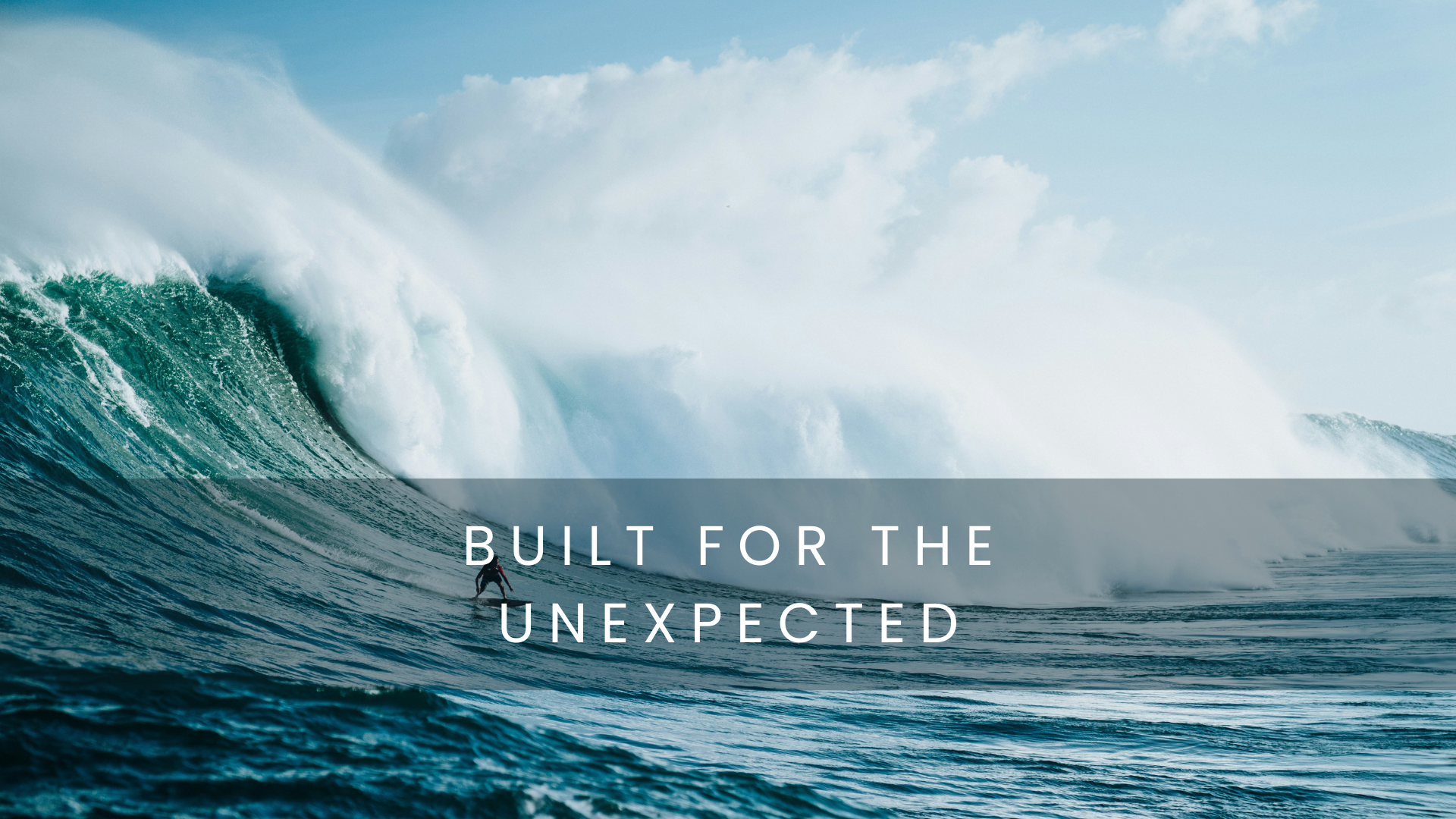
Most leaders optimize for efficiency. The ones who last optimize for what survives the shock.
For decades, Boeing was the gold standard of American engineering. It built the 747. It shaped modern commercial aviation. It was the kind of company engineers dreamed of joining.
Then, over the course of two decades, leadership made a series of decisions that looked entirely rational in isolation.
They moved headquarters away from the engineers. They outsourced increasingly critical components to reduce cost. They prioritized financial performance over engineering depth. They removed redundancy in the name of efficiency.
Each decision improved a metric. Each decision was defensible in a boardroom. And each one removed a layer of protection that had been built over decades of learning what it takes to keep airplanes safe.
The consequences arrived in 2018 and 2019, when two 737 MAX crashes killed 346 people. Investigations showed that the failures were not the result of one isolated technical error. They were the downstream consequence of an organization that had gradually stripped away the engineering culture, the internal challenge, and the safety margins that once made it exceptional.
Boeing did not fail because of one bad decision. It failed because years of optimization created a system that looked stronger in a quarterly review and weaker in reality. When conditions changed, what remained was not enough.
I have seen smaller versions of this pattern throughout my own career.
Organizations restructure to improve the OPEX ratio and then discover they no longer have the capacity to respond when the market shifts. Teams lose their strongest people not during the restructuring itself, but months later, when the remaining workload becomes unsustainable and there is no bench, no backup, no margin for the unexpected.
I did not have a word for what I was seeing until I read Antifragile by Nassim Nicholas Taleb.
Taleb's argument is not that the world is uncertain. That part is obvious. His argument is more uncomfortable: most organizations, and most leaders, are built in ways that break under uncertainty instead of benefiting from it.
He introduced a concept that changed how I think about risk: antifragility.
Not resilience, which means surviving the shock and returning to where you were. Antifragility means becoming stronger because of the shock. The stress improves you. Volatility becomes an advantage.
A resilient organization absorbs a crisis and recovers. An antifragile organization uses the crisis to learn faster, adapt faster, and emerge stronger than before. The difference between the two is usually determined long before the crisis arrives. It is embedded in how the organization was designed when things were still going well.
What struck me was how directly this applied to the decisions I had been part of throughout my career. Restructurings, workforce planning, talent moves, organizational redesign. They all came down to the same tradeoff: efficiency versus adaptability.
And almost every system rewards efficiency.
One of Taleb's ideas that immediately changed how I think is deceptively simple: never risk ruin.
Not every mistake matters equally. Some decisions are reversible. You make a bad hire, you correct it. You launch an initiative that fails, you stop. You enter a market too early, you pull back and learn.
But some decisions, if they go wrong, remove your ability to recover.
Too much leverage when demand contracts. A single strategic bet that consumes all capital and attention. A restructuring so deep that it removes the institutional knowledge needed to rebuild. A shortcut that damages trust in a way that takes years to restore.
Many leaders evaluate these decisions as if they were reversible. They model probabilities, present scenarios, compare upside.
Taleb's point is that when the downside is catastrophic, the probability is almost irrelevant.
A 90 percent chance of success is meaningless if the 10 percent outcome is irreversible.
In people decisions, this appears more often than we admit.
A restructuring may improve cost. It may also remove the exact capability the business will need six months later. A spreadsheet cannot tell you the difference. The numbers only capture the immediate savings. They rarely capture the strategic capacity that disappeared with the role.
You can make a company look more efficient by reducing headcount. You can also make it dangerously fragile.
The distinction is not how many roles you remove. It is whether you are removing cost or removing adaptability.
Some roles are not cost. They are optionality. They are the capacity to respond when the business changes faster than expected.
Another idea that stayed with me was how Taleb thinks about opportunity.
Most leaders are trained to ask what they think will happen. They forecast, model scenarios, and commit to the outcome that appears most likely.
Taleb asks a better question: what happens if we are wrong?
The best decisions are not necessarily the ones where you predict correctly. They are the ones where the cost of being wrong is limited and the benefit of being right is disproportionately large.
A small pilot before a large rollout works because failure is contained and learning is immediate. Hiring a high potential leader during a downturn can look expensive in the moment, but the upside when the market turns can be enormous. Investing in capability while competitors are cutting often feels uncomfortable precisely because the payoff is not visible yet.
This is what Taleb means by asymmetry.
The opposite is equally important. Any decision that removes all buffers to protect a short term result may improve this quarter and weaken every quarter after that.
The idea from Taleb that felt most familiar was his concept of via negativa.
I had been practicing it long before I knew it had a name. Early in my career, working inside organizational structures where the mandate was always to optimize, to do more with less, I learned that the fastest way to create impact was not to add. It was to remove. Remove the process nobody questioned. Remove the report nobody read. Remove the initiative that consumed resources without producing results.
In Latin America, this is harder than it sounds. There is a cultural expectation to say yes, to accommodate, to avoid being the person who pushes back. Saying no can be read as resistance, as a lack of commitment, as not being a team player. But I learned early that saying no to the wrong things was what created space for the right ones. That skill helped me grow more than almost any other.
Taleb gave it a framework: improvement through subtraction. Many organizations improve faster by removing what is making them weaker than by adding something new.
A process that adds time but not value. A metric that drives the wrong behavior. A meeting that consumes leadership energy but produces no decision. A high performer whose individual output comes at the expense of trust across the team.
Some of the strongest decisions I have seen leaders make were not about introducing something new. They were about removing something that had quietly become destructive.
Taleb also made me rethink something many organizations undervalue: safety buffers.
Redundancy looks inefficient in a spreadsheet. In reality, it is often what keeps a system alive.
Extra cash. Talent depth beyond the minimum. A second supplier. Time built into a plan. A successor who is ready before the role opens.
Nature uses redundancy everywhere because systems without safety buffers do not survive long enough to optimize.
This is especially relevant in workforce planning.
The pressure is almost always to run at the minimum. The minimum headcount to deliver the plan. The tightest structure. The leanest model.
That works only when the environment behaves as expected.
But environments rarely do.
People resign unexpectedly. A market turns. A leader leaves. A customer shifts demand. A project suddenly doubles in scope.
Without safety buffers, every surprise becomes a crisis.
With safety buffers, the same event becomes manageable.
The challenge for leaders is not defending inefficiency. It is understanding the economics of preparedness. The cost of having a buffer often looks high until compared with the cost of being unable to respond.
The part of Antifragile that felt most practical to me was how it applies to cyclical markets.
Every industry moves through expansion, contraction, and recovery. Yet many organizations still behave as if current conditions will last indefinitely.
During strong markets, many companies overhire and overexpand. During downturns, they cut too deeply and freeze the investments that would make them stronger.
The organizations that emerge strongest do something different.
When the market is weak, they prepare. They strengthen the balance sheet, upgrade talent, simplify operations, and invest in productivity. They use the quiet period to build capabilities others postpone.
When the cycle turns, they are already positioned. They move faster because they invested when others were retreating.
And when the market is strong, they take advantage of momentum without mistaking favorable conditions for superior judgment.
I have seen organizations navigate cycles well. I have seen others miss them completely.
The difference is rarely the strategy deck.
It is whether leadership had the discipline to invest in strength during weakness, instead of waiting for permission from results that had not arrived yet.
I did not read Antifragile as a business book. I read it as a book about how to think when you cannot know what happens next.
What stayed with me was not a model. It was a different question.
Initially, the question I asked before a major decision was: what is the most likely outcome, and are we positioned for it?
Now the question is different.
If we are wrong about the outcome, does this decision still hold?
And if the shock is worse than expected, do we still have enough trust, enough depth, and enough optionality to move?
That question has not made decisions easier. It has made them more honest.
Because strategy is not proven when the market behaves as expected.
It is proven when conditions change and the organization still has enough depth to respond.
The leaders who last are rarely the best forecasters.
They are the ones who built something that did not need the forecast to be right.